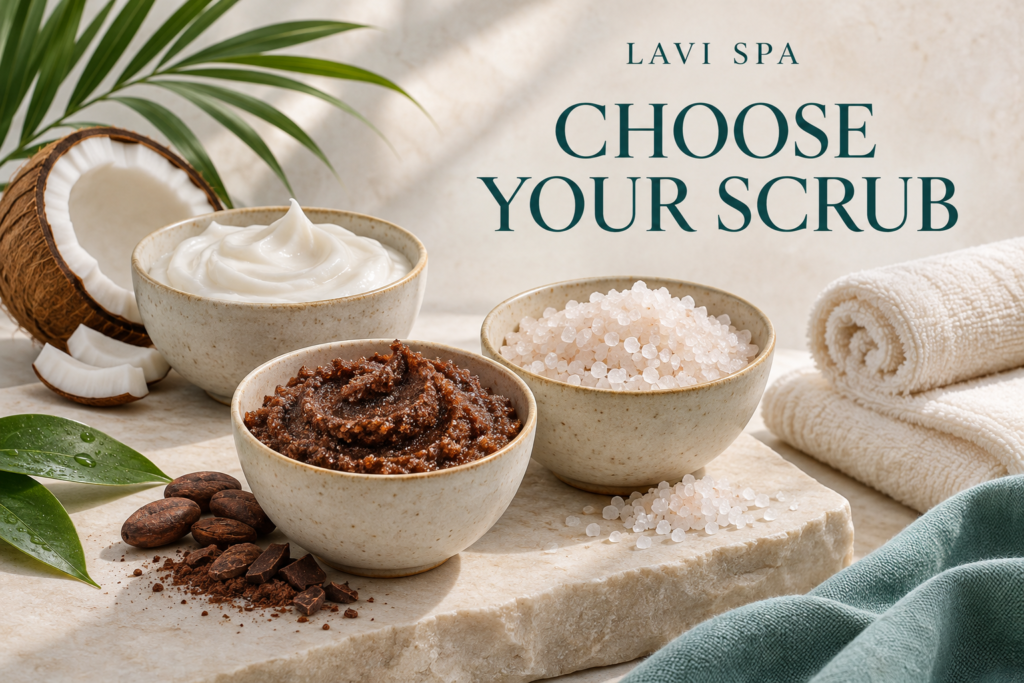
Coconut, chocolate and Red Sea salt describe three scrub options on Lavi Spa’s menu. Their names help you identify a service, but they do not tell you every ingredient, the exact texture or how the product will feel to you. Comparing them starts with the published descriptions and then narrows to your preferences.
This is a guide to reading those options. It does not rank one scrub as medically better, promise a particular skin result or treat a food-related name as a complete product label.
What the descriptions actually distinguish
| Menu option | Emphasis in the published description | Useful follow-up |
|---|---|---|
| Coconut Scrub | Coconut-based exfoliation with a coconut scent | Ask about the current product and its fragrance |
| Chocolate Scrub | Chocolate-based exfoliation with a chocolate scent | Clarify whether that aroma is one you would enjoy |
| Red Sea Salt Scrub | Salt-based body exfoliation | Ask about the actual texture and application |
You can read the individual Coconut Scrub, Chocolate Scrub and Red Sea Salt Scrub descriptions before making a shortlist. The differences above come from those pages; they are not a laboratory comparison of the formulations.
Begin with the sensory experience
Some people enjoy a recognisable sweet scent during a spa treatment; others would rather avoid it. That preference is a useful starting point. Say what you enjoy in ordinary language instead of trying to guess which ingredient is supposed to deliver the strongest effect.
Texture is a separate question. A product name alone cannot reliably tell you the size or feel of its exfoliating particles. Ask the team to describe or show the product used for the appointment. Avoid assuming that every salt scrub feels identical or that every coconut product has the same consistency.
A name is not a full ingredient list
A chocolate-themed service may contain more than its named ingredient, just as a coconut-themed service is not necessarily pure coconut. If a particular ingredient matters to you, ask about the actual product before agreeing to its use. A general menu description cannot answer a formulation-specific question.
Keep preferences and restrictions distinct. “I dislike a strong fragrance” and “I need information about a particular ingredient” are different messages. Giving the relevant detail helps the team address the right question rather than interpreting both as a request for a lighter scent.
Confirm the service, not only the product
Once you have a preferred option, establish the appointment’s coverage, duration and finishing steps. Do not assume that choosing a named scrub automatically adds massage, a mask or another spa stage. If you are looking at a package, check its inclusions separately from the standalone service description.
During the appointment, clear feedback about comfort is more useful than silently expecting the product name to determine the pressure. If you want a pause or a change, say so directly and let the therapist explain the available options.
Make a short, specific choice
A practical enquiry is: “I am interested in [scrub name]. I prefer [scent or texture preference]. Please confirm the product, duration and what the appointment includes.” Use the Lavi Spa contact page to clarify those details before booking. The right comparison is the one that makes the actual experience clear to you.